On this page
Last checked: 29 October 2026
Badminton is a racket sport played by hitting a shuttle over a net. Singles has one player per side; doubles has two. The aim is to land the shuttle inside the other side’s court before it can be returned. For your first session, focus on a place to play and a patient partner.
The confusing part is knowing what to learn first. Court lines overlap, doubles service changes look complicated, and equipment advice can make a simple first game feel expensive.
This guide takes you from booking a court to playing that game. Use the sample session to put the equipment, simple skills, and rules together.
Where should you start?
Find an indoor court and arrange a beginner-friendly session before buying equipment. Ask about racket rentals, shuttle supply, shoe requirements, and whether you need a partner. A casual group or introductory coaching session can solve several of these problems together.
Search nearby sports halls, badminton academies, community centers, or booking platforms. Indoor play removes wind while you learn to judge the shuttle.
Before booking, confirm:
- Who can join: Is the session open to absolute beginners?
- What is included: Are rackets, shuttles, or shoes available to rent?
- How booking works: Is the charge per court, person, or session?
- What to wear: Does the hall require clean, non-marking court shoes?
- Who will play: Can the organizer match you with a partner?
Agree with your partner that you want gentle rallies and a simple game.
What equipment do you need?
You need a serviceable racket, suitable footwear, a shuttle, and comfortable clothes. Borrowing or renting is enough to try badminton. Check the venue’s footwear policy before traveling, and leave specialist racket specifications until you know what feels comfortable in your hand.
Item | What to check for your first session |
|---|---|
Racket | Comfortable grip, intact strings, no visible frame damage |
Shoes | Venue-approved court footwear with a secure fit and suitable grip |
Shuttles | Ask which type the group uses and who supplies them |
Clothing | Enough freedom to reach, bend, and step comfortably |
Personal items | Water, a towel, and any venue-required booking details |
Try another rental if the racket feels difficult to control. The Sport Singapore equipment guide offers a useful starting checklist.
Feather and synthetic shuttles feel different in flight. Start with the type your group uses.
How do you hold the racket and move?
Begin with a relaxed grip and small, controlled steps. Your hand should be able to change position on the handle. Move toward the shuttle before swinging, strike within a comfortable reach, and recover your balance before preparing for the next shot.
How do the basic grips work?
For a basic forehand grip, hold the racket as though shaking hands with its handle. Your thumb and index finger form a loose V. For simple backhand shots in front of you, turn the handle and place your thumb against its broad rear surface.
Avoid holding the racket like a frying pan for every shot. Keep your fingers relaxed between contacts, then briefly firm the grip as you hit. Different shots need small grip adjustments; these two positions are starting points.
Practice changing grips without a shuttle. BWF’s Shuttle Time teaching manual illustrates the V and thumb grips; ask someone experienced to check yours.
How do you move without chasing every shot?
Start with knees slightly bent, feet comfortably apart, and the racket ready in front. Time a small readiness hop so you land ready to move as your partner strikes, then step toward the shuttle. After contact, recover to a useful position instead of watching your shot from where you finished.
Practice one step forward, a controlled reach, and a step back without hitting. Keep the movement slow enough to stop in balance.
For an overhead shuttle, turn and move into position rather than running backward without looking. A clear feed from a partner is easier to learn from than an unpredictable rally.
Which shots should you learn first?
Learn to send the shuttle over the net consistently before adding power. Start with a serve, an underarm lift, and a controlled overhead clear. Add a gentle net shot once you can reach the front court in balance. A smash can wait.
Shot | What you are trying to do |
|---|---|
Serve | Start the rally legally into the opposite diagonal service court |
Lift | Send a low shuttle upwards toward the opponent’s rear court |
Clear | Send an overhead shuttle high and deep to create time |
Net shot | Guide the shuttle softly over the net from the front court |
Choose height and control over speed so your partner has time to return the shuttle.
Use an easy swing and meet the shuttle in front where possible. Overhead hitting involves coordinated body, arm, and forearm movement; avoid trying to generate every shot by flicking your wrist.
Try a cooperative target: five contacts between you. If rallies keep ending immediately, practice with one person gently feeding shuttles and the other returning them.
What rules do you need for a first game?
You need to know how a rally ends, which lines apply, and how points and service work. Agree on the scoring format before you begin. Try singles for a straightforward first game.
How do you win a rally and count points?
A rally starts with a legal serve. Return the shuttle before it touches the floor; badminton has no bounce. Win by landing it inside the opponent’s court, or when your opponent commits a fault. Under rally scoring, the winning side gains a point and has the next serve. A shuttle touching a boundary line is in.
Scoring check — 29 October 2026: The current standard BWF match is best of three games to 21 points: win two games to win the match. At 20–20, a side needs a two-point lead; at 29–29, the next point wins. BWF has approved best-of-three games to 15 from 4 January 2027, with some competitions introducing it earlier. Check your session or competition rules.
Sources: current BWF Laws of Badminton, Japan Badminton Association approval notice, and Sweden’s early adoption notice.
For a casual first session, you can agree to a shorter practice game. Call it a practice format so nobody mistakes it for the official match format.
In singles, serve from the right service court when your score is even, including zero. Serve from the left when it is odd. At 0–0 you start on the right; after winning that rally, you serve from the left at 1–0. If you lose the next rally, your opponent serves at 1–1 from their left court.
Which court lines are in?
Singles uses the inner side lines; doubles uses the outer side lines. During rallies, both use the back boundary. Service has extra limits: a doubles serve must land on or before the doubles long service line, while a singles serve can reach the back boundary.
In both formats, the serve must cross the net diagonally and reach or pass the short service line. A serve landing on the relevant boundary line is in.
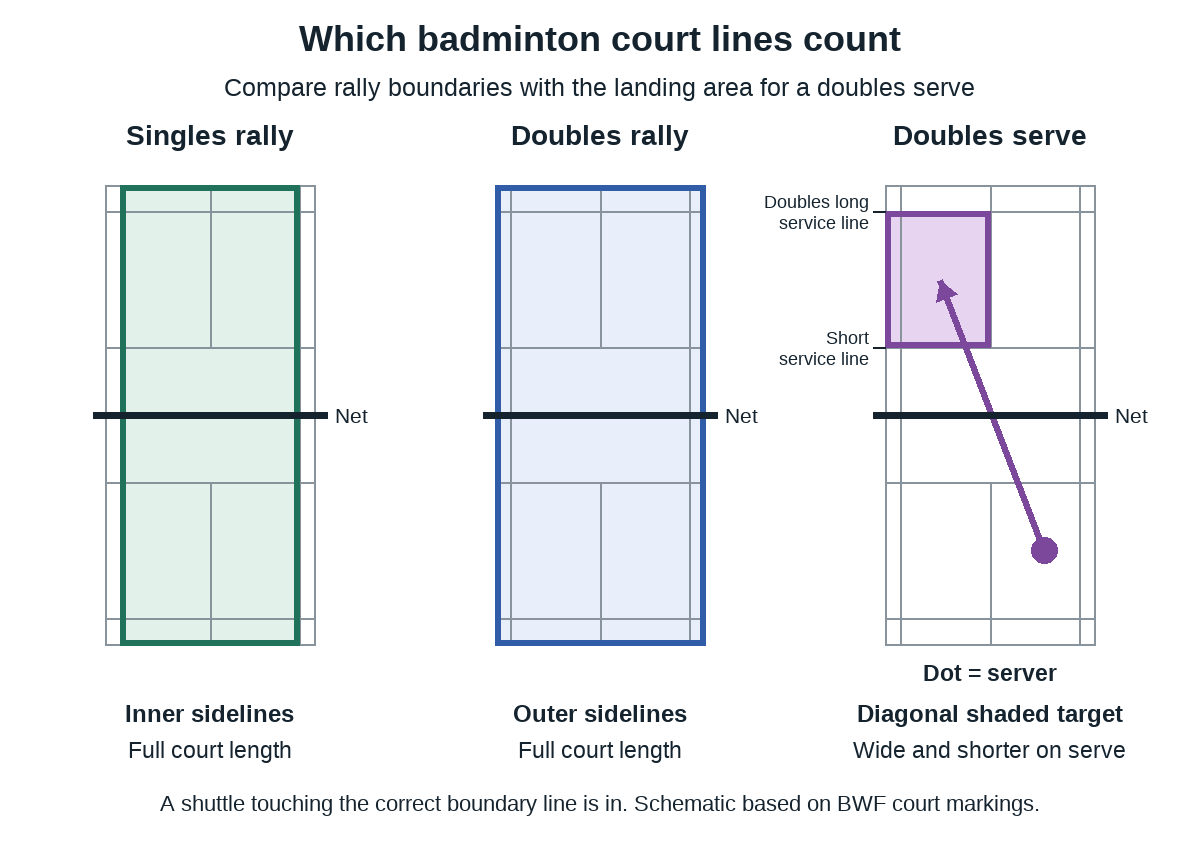
The first two panels show rally boundaries; the third shows one doubles serve landing area. Singles service uses the narrow diagonal box from the short service line to the back boundary. After a doubles serve is returned, the full doubles rally court applies again. Compare the markings in Badminton England’s court design guide.
What counts as a fault?
Common faults include hitting out, failing to send the shuttle over the net, touching the net with your racket or body while the shuttle is in play, or catching and carrying the shuttle on the racket. A fault ends the rally and gives the other side the point.
In doubles, partners cannot take consecutive hits before returning it across the net. The BWF Laws define faults and lets in Laws 13–14.
A “let” stops play and repeats the rally without changing the score in situations covered by the rules.
How do you serve?
Stand inside your service court and send the shuttle upward over the net into the diagonally opposite service court. Start with a compact, controlled swing. During delivery, parts of both feet must remain still and touching the floor; contact must happen with the whole shuttle below 1.15 meters (about 3 feet 9 inches) above the court floor.
Use this beginner checklist:
- Check your score and choose the correct service side.
- Check that both you and the receiver are inside opposite diagonal service courts, off the lines. Both players must keep part of each foot still on the floor during delivery.
- Wait until the receiver is ready.
- Release the shuttle without adding spin, and strike its base first.
- Move the racket forwards continuously through delivery, keeping the required foot contact until the shuttle is struck.
The height rule is a fixed measurement, not “below your waist.” Ask for help checking it rather than assuming a waist-high contact is legal.
These points follow Law 9 of the BWF Laws of Badminton.
For a first drill, use a small underarm swing and aim to land five serves in the correct box. Hold the shuttle in front, release it without spin, and send its base upward across the net with a smooth forward racket movement. Placement matters more than speed.
How should you share a court?
Wait for a rally to finish before walking behind players or retrieving a shuttle. Keep bags and loose equipment outside the playing area. In doubles, agree who takes a shuttle between you and call early enough for your partner to respond.
If a stray shuttle or another hazard enters your court, stop and make the other players aware. Do not keep swinging while someone bends down near you.
Call the score before serving. Make line calls clearly and discuss uncertain calls calmly. A social group may agree to replay a disputed rally, but that agreement should not be presented as the official rule for every dispute.
What could your first 60 minutes look like?
Use the first hour for preparation, simple contacts, and a short game. Adapt this example with shorter blocks, breaks, and help whenever you need them.
Time | Activity | Simple focus |
|---|---|---|
0–10 minutes | Walk, move gently, and rehearse easy steps and swings | Get familiar with the space |
10–20 minutes | Practice grip changes and gentle partner feeds | Comfortable contact |
20–30 minutes | Serve into the correct diagonal box | Repeatable placement |
30–45 minutes | Cooperative rallies, with breaks as needed | Keep the shuttle in play |
45–55 minutes | Play a short agreed game | Call the score and use the lines |
55–60 minutes | Finish gently and review | Choose one focus for next time |
Total: 60 minutes. During rallies, reset whenever the exercise becomes rushed. Finish by naming one thing that improved and one thing that still feels unclear.
To start a casual singles practice game, agree on its length and who serves first. Begin at 0–0 with the server on the right, facing the diagonal receiver. Say the server’s score first before every serve. Play the rally, award the point, and use the next server’s own score to choose right or left. Formal matches use a toss to settle the initial choice of service or ends.
How can you practice over four weeks?
Choose one main skill each week and revisit earlier skills briefly. Treat this as a flexible example, repeating a week whenever useful. Your progress will depend on your starting point, practice, and feedback.
Week | Main focus | What to notice |
|---|---|---|
1 | Grip, easy contact, and service boxes | Can you explain where your serve should land? |
2 | Stepping toward the shuttle and recovering | Can you finish a gentle return in balance? |
3 | Lifts, clears, and cooperative rallies | Can you choose height instead of rushing? |
4 | Short games with scoring and line calls | Can you keep track without losing your place? |
Record one observation: serves landing in the box, your longest rally, or a rule you now understand. Use it to choose your next practice.
Which beginner mistakes should you avoid?
Avoid gripping too tightly, trying to smash every shuttle, and buying equipment before checking what you need. The most useful correction is usually one clear change at a time. Ask a partner or coach to watch a specific action, such as your grip or service position.
If you keep missing, slow the feed down. If every return flies out, reduce force and check contact. If you are late to the shuttle, rehearse the movement without hitting first.
Frequently asked questions
Can adults learn badminton with no previous experience?
Yes. Adults can begin with gentle feeds, simple movement, and short games. Tell the organizer that you are an absolute beginner so you join a suitable session. Choose a manageable pace and build from what you can repeat comfortably.
Do I need coaching before my first game?
No. You can try a casual game with a patient partner. An introductory lesson can help you check grips, serving, and movement before confusing habits build up. Choose coaching when you want feedback or struggle to understand a particular action.
Can I practice badminton alone?
Yes. You can rehearse grip changes, controlled steps, and serves on a booked court. Leave enough clear space for your racket. A partner or group is still needed to practice reading an opponent’s shot and sustaining normal rallies.
Is singles or doubles better for beginners?
Either can work. Singles makes service order easier to follow, while doubles lets you share court coverage with a partner. Doubles also requires communication and extra service rules. Choose the format offered by a supportive beginner session.
Can I start with a borrowed racket?
Yes. A borrowed racket is suitable if its frame and strings are intact and the grip feels secure. Try it through easy swings first. If the handle slips or the racket feels awkward, ask to borrow a different one.
Are running shoes suitable for an indoor court?
Check the venue’s requirements before using them. Running shoes may fail its court-footwear policy, and a non-marking sole alone does not establish suitability. Ask the venue about appropriate indoor court shoes or rental options before arriving.
Can I learn outside before booking a court?
Yes. Outdoor hitting can help you become familiar with racket contact. Wind changes the shuttle’s flight, so outdoor results will not translate directly to indoor rallies. Use a clear area and leave plenty of space between people swinging rackets.
How many shuttles should a beginner bring?
First ask whether shuttles are supplied. If you must bring your own, agree on the type with your partner and bring spares. The number you use depends on the shuttle type, its condition, and how your group practices.
How long does it take to become good at badminton?
There is no fixed beginner timeline. Practice frequency, feedback, and your starting point affect progress. Use specific signs such as landing serves legally or sustaining a cooperative rally. These give you a clearer next step than a vague deadline for becoming “good.”
What should I do if I cannot keep a rally going?
Switch to gentle feeds instead of continuing competitive points. Let one person send easy shuttles while the other returns them, then swap. Reduce distance or pace where appropriate and focus on clean contact before adding movement or harder shots.
What should you do next?
Start with a court, a partner, and suitable borrowed or rented equipment. Learn relaxed contact, a legal serve, and the lines before chasing power. Use short practice blocks and a simple game to connect those skills.
Before your next available session, confirm the booking, footwear policy, and shuttle arrangements. At the session, aim to land a few legal serves and build a cooperative rally. Afterwards, choose one skill to repeat.
Arrange that first beginner-friendly hour. Give yourself one clear skill to build on next time.
Explore the beginner collection
- Badminton Rules Explained for Beginners
- How Badminton Scoring Works: Examples for Singles and Doubles
- Badminton Serving Rules: Position, Technique, and Common Mistakes
- Badminton Court Dimensions and Lines Explained
- Singles vs. Doubles Badminton: Rules, Court Coverage, and Playing Style
- Badminton Faults and Lets: What Happens in Common Situations?
- Badminton Shots Explained: Clear, Drop, Smash, Drive, Lift, and Net Shot
- Badminton Terms Explained: A Beginner’s Glossary
- Your First Indoor Badminton Session: What to Bring and What to Expect
Explore the next step: a practical first-month plan and selected New Jersey facilities.