On this page
Last checked: 29 October 2026
Stand on a badminton court for the first time and the floor can look like several games drawn over one another. You may see two side lines, two back lines, and a line near the net that sometimes matters and sometimes does not.
The solution is to separate the court's size from the area used for a particular shot. This guide explains the standard measurements, shows which lines apply to singles and doubles, and gives you a quick way to check them before playing.
What are the standard badminton court dimensions?
A standard full court measures 13.4 meters long by 6.1 meters wide for doubles. Singles keeps the same length but uses a 5.18-meter width. The net divides the length into two equal halves. These are playing-court measurements, rather than the size of the surrounding sports hall.
Measurement | Official metric | Approximate imperial |
|---|---|---|
Full court length | 13.4 m | 44 ft |
Doubles width | 6.1 m | 20 ft |
Singles width | 5.18 m | 17 ft |
Short service line from net | 1.98 m | 6 ft 6 in |
Doubles long service line inside baseline | 0.76 m | 2 ft 6 in |
Court line width | 40 mm | 1.57 in |
The metric figures govern. Rounded imperial equivalents are useful for recognition, but should not be used to lay out a competition court. For example, 44 feet is slightly longer than 13.4 meters.
These dimensions come from Diagram A of the BWF Laws of Badminton and the court plan in Badminton England's design guidance. Singles width follows from the inner sidelines: 6.1 meters minus 0.46 meters on each side equals 5.18 meters.
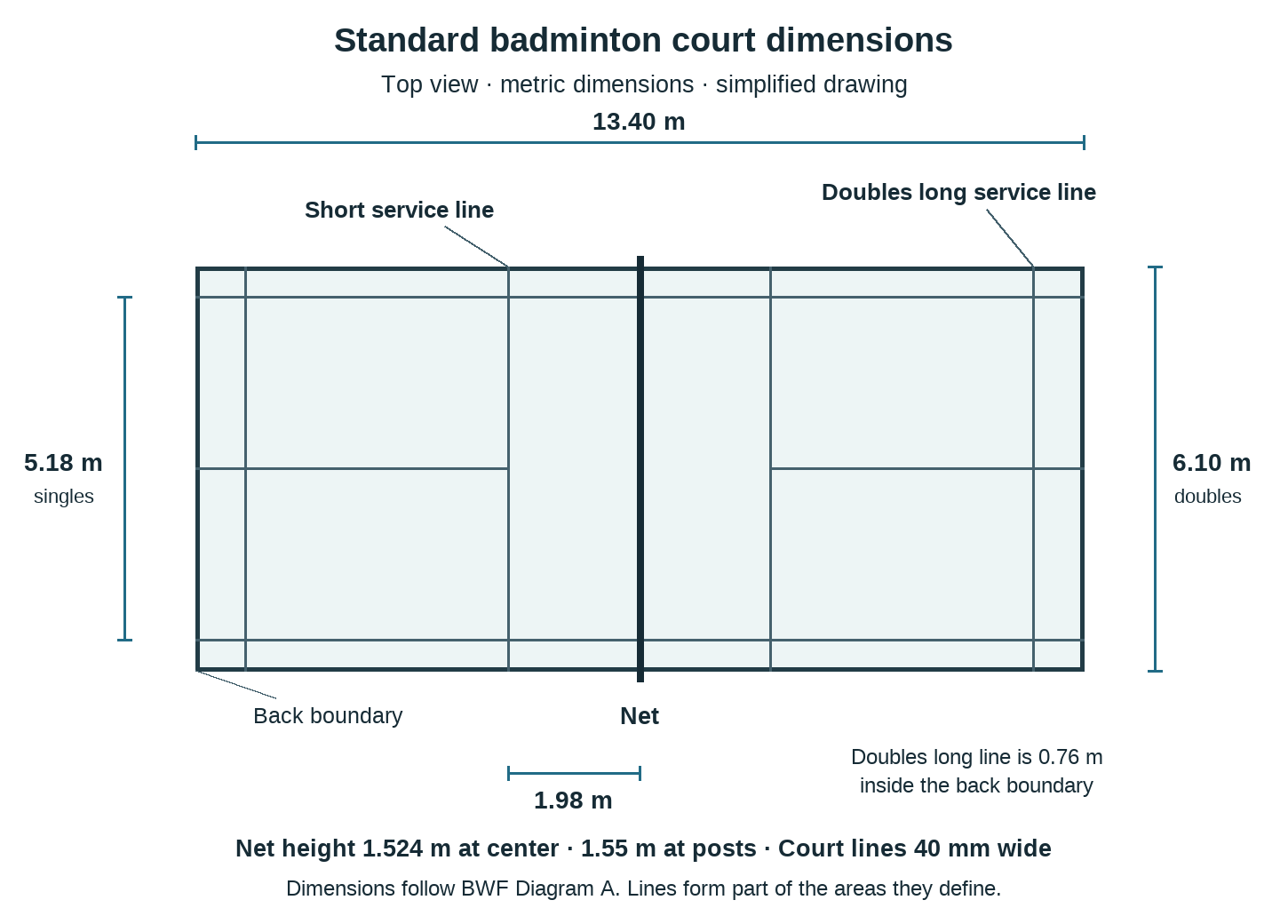
The diagram shows the conventional full-court layout. Para badminton uses class-specific court diagrams, explained below.
What does each badminton court line mean?
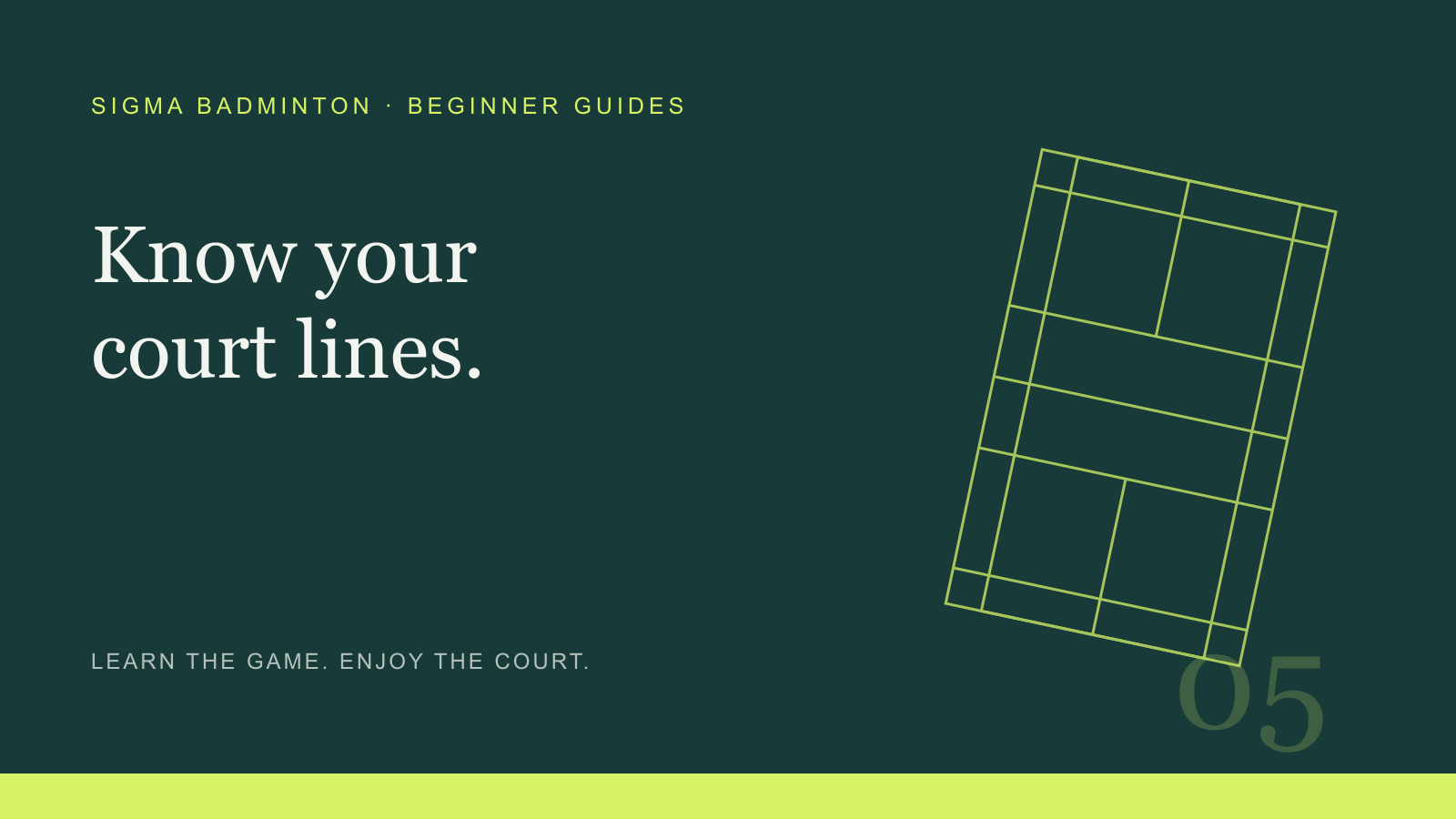
The outer rectangle marks the doubles rally court. The inner sidelines narrow it for singles. Across each half, the short service line sets the front limit for serve landings; the doubles long service line sets their rear limit in doubles. The center line divides left and right service courts.
Which line is the back boundary?
The back boundary, often called the baseline, is the farthest line from the net on each half. It is the rear landing limit during both singles and doubles rallies. It is also the long service line for singles.
The line just inside it has a different job: it limits doubles serves. Beginners sometimes use that inner line for every doubles shot. That shortens the rally court incorrectly. After the serve is returned, a doubles shot may land all the way back to the baseline.
Which side line belongs to singles?
The sideline closer to the center of the court belongs to singles. The outer one belongs to doubles. The strips between them are often called side tramlines.
Imagine a shuttle landing halfway between those two sidelines. It is outside the singles court, but inside the doubles court during a rally. The shuttle has not changed location; the chosen format has changed the relevant boundary.
What is the center line for?
The center line separates each half into right and left service courts. Right and left are viewed from the player's own end, facing the net. A server on their right faces a receiver in the opposite diagonal service court.
There is no rule requiring rally shots to stay on one side of that line. Once the serve is returned, the entire applicable singles or doubles court is available. Treating the center line as a permanent divider would remove useful cross-court shots and confuse doubles coverage.
The line names and service-box distinctions are also illustrated in Badminton England's rules teaching resource, Section 7. Its older service-height wording should not replace the current BWF service law.
Which lines count during singles and doubles rallies?
Singles is narrow and full length; doubles is wide and full length. During a rally, neither the short service line nor the doubles long service line creates an internal out-of-bounds area. Their service-related jobs do not turn the middle or rear of the rally court into separate zones.
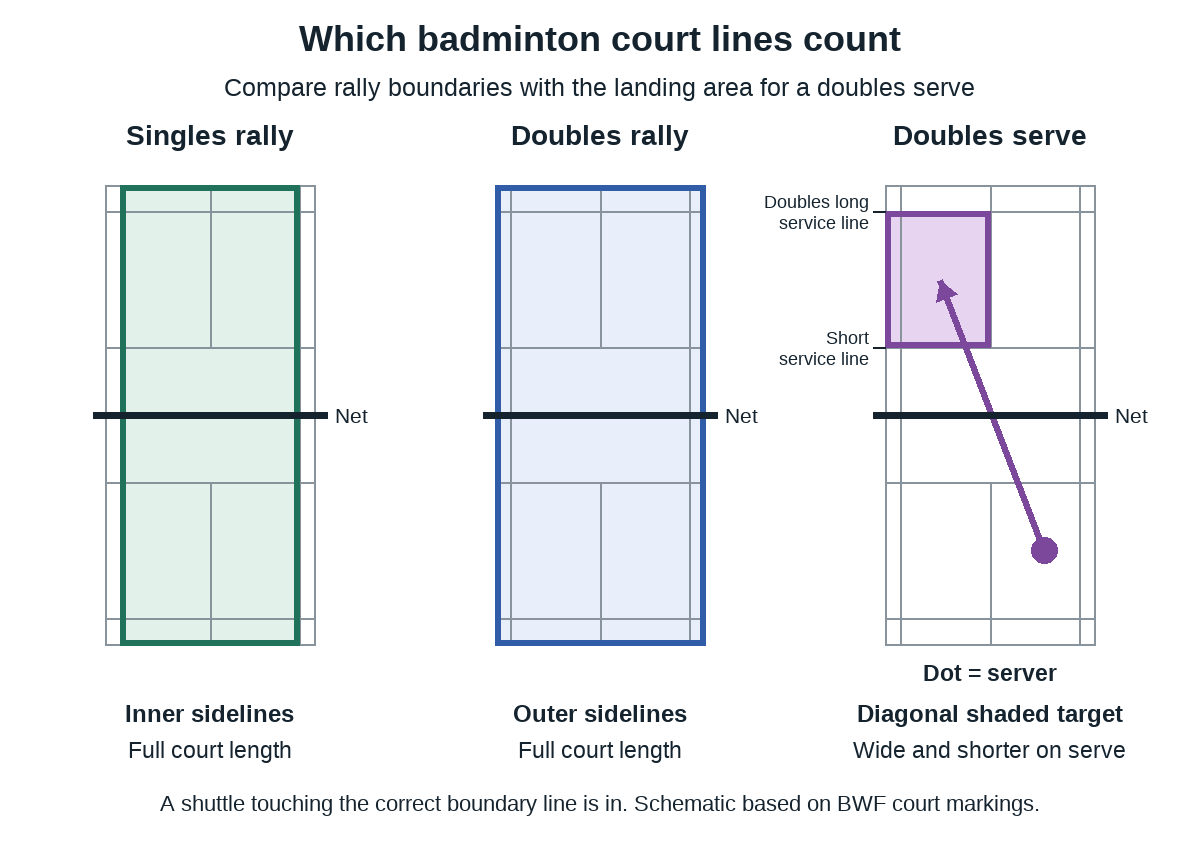
The first two panels show rally boundaries. The third shows one doubles service landing area, rather than the entire area available after the serve has been returned.
Try these checks before a game:
- Singles shot in a side tramline: out.
- Doubles rally shot in a side tramline: in, provided it is on or inside the other relevant boundaries.
- Doubles rally shot between the inner back line and baseline: in.
- Either format's shot beyond the back baseline: out.
If your hall marks several sports in different colors, ask which color belongs to badminton. Trace the complete rectangle instead of guessing from a single line near your feet. Nets, neighboring courts, or faded markings can make an isolated line misleading.
Where must a singles or doubles serve land?
A serve travels diagonally into the receiver's service court. Singles uses a long, narrow box: inner sideline to center line, short service line to baseline. Doubles uses a shorter, wider box: outer sideline to center line, short service line to doubles long service line.
For both formats, a serve may land on the short service line. It cannot land in the area between that line and the net. Likewise, the appropriate rear line counts as in: the baseline for singles, or the doubles long service line for doubles.
Use this sequence when checking a serve:
- Identify whether the game is singles or doubles.
- Find the receiver's diagonal service court.
- Check the front boundary at the short service line.
- Check the correct sideline and rear boundary.
This describes the landing area, not every requirement for a legal serve. The server and receiver must also stand inside their proper service courts without touching the boundary lines; part of both feet stays stationary on the floor through delivery. Under standard BWF Law 9, the whole shuttle must be below 1.15 meters above the court at contact. A correct landing does not cancel a separate service fault. See BWF Laws 9–11.
Is a shuttle on a line in or out?
A shuttle landing on the relevant boundary line is in. The important word is relevant: a line may be inside one format's court and outside another's. For standing players under the conventional court rules, use the shuttle's landing rather than the position of the player's feet to decide a boundary call.
For example, landing on the doubles sideline is in during a doubles rally. The same landing is out in singles because the singles boundary is farther inward. Landing on the doubles long service line is in for a correct doubles serve; landing beyond it is out even if the shuttle stays inside the rally baseline.
The BWF court law, clause 1.3, makes the lines part of the areas they define. It does not mean every colored line on a shared hall floor is a badminton boundary.
How high is the net, and where do the posts stand?
The net is 1.524 meters high at its center and 1.55 meters over the doubles sidelines. The posts are 1.55 meters high and stand on the doubles sidelines, including when singles is played. The center is therefore slightly lower than the sides; the net should not be set to one arbitrary height everywhere.
In approximate imperial terms, the center is 5 feet, while the sides are 5 feet 1 inch. BWF Law 1 also specifies a net at least 6.1 meters wide and 760 millimeters deep. These figures describe different directions: width runs across the court; depth runs vertically down from the top.
At a rented court, report a loose, visibly sagging, or displaced net to the venue. Avoid moving weighted post bases into the playing area to improvise a repair. A properly set net needs suitable equipment and placement, not just the correct number on a tape measure. See BWF Laws 1.4–1.11.
How much space is needed around a court?
The playing rectangle is only part of a usable venue. Players need clear space beyond the boundaries, and the hall also needs appropriate height, lighting, access, and circulation. A room that fits a 13.4-by-6.1-meter rectangle does not automatically provide a suitable badminton facility.
Sport England and Badminton England's design guidance separates the marked court from surrounding run-off and facility requirements. That document dates from 2011; it is useful context, rather than a complete current construction specification for every country or competition.
For a booking, look for bags, benches, walls, or adjacent activity close to the court. Ask staff about anything that restricts movement. For a new facility, obtain current governing-body guidance and qualified design advice covering the intended playing level and local building requirements. Do not copy a recommended clearance from an old diagram and describe it as a universal rule of play.
Accessibility also goes beyond court size. Clear routes to the court, room to change ends, and facilities suitable for the players using them matter alongside the markings.
Do all badminton players use the same court layout?
The conventional full court is a useful starting point, but Para badminton has class-specific provisions. The BWF Laws include separate diagrams for wheelchair badminton and standing classes playing half-court. A beginner adaptation for a lesson is also different from an official competition layout.
Check BWF Diagram A and Para badminton Diagrams D–F with the organizer or coach for the applicable format. Avoid assuming that “singles is always this entire narrow rectangle” applies to every Para class.
For casual learning, a coach may reduce an area or use targets to practice control. Label that as an exercise. It helps participants understand why a practice boundary may differ from the next formal game.
Frequently asked questions
Is a badminton court 44 feet long?
Approximately. The official length is 13.4 meters, equivalent to about 43 feet 11.6 inches. “44 feet” is a convenient rounded description, not the figure to use for precise marking.
Is singles shorter than doubles?
The conventional singles rally court is narrower, but the same length. The shorter rear landing limit belongs to doubles service, which is why the two ideas are easily confused.
What does “tramline” mean?
It is a common informal name for the parallel strips beside the singles sidelines or near the back boundary. Name the exact boundary when discussing a call because side and rear tramlines have different uses.
Can a serve land on the center line?
Yes, if it is the boundary of the correct diagonal service court and the other service requirements are met. The server and receiver cannot stand on their service-court boundary lines during delivery.
Is the area near the net out during a rally?
No, in the conventional full-court game. The strip between the net and short service line is excluded for serve landings, but a later net shot may land there.
Do the net posts move inward for singles?
No. The standard posts remain on the doubles sidelines. The singles boundaries change which shuttle landings count; they do not relocate the posts.
Are the court lines included in its dimensions?
The boundary lines form part of the court areas. Use the official dimensioned drawing for marking rather than adding a new line width outside a rectangle based on rounded measurements.
Will the 2027 scoring change resize the court?
No change to the conventional court dimensions appears in the approved BWF Laws effective 4 January 2027. Those laws change standard scoring; their court drawing retains the same layout. See the future BWF edition.
How can you check the court before your next game?
Face the net and name the inner sideline, outer sideline, baseline, short service line, and doubles long service line. Then point out one legal singles service box and one legal doubles service box.
Finish by checking the format with your partner. Knowing which rectangle applies is more useful during play than reciting all the measurements. Keep the dimensioned diagram for reference, and use the rally-versus-service distinction for your next line call.